

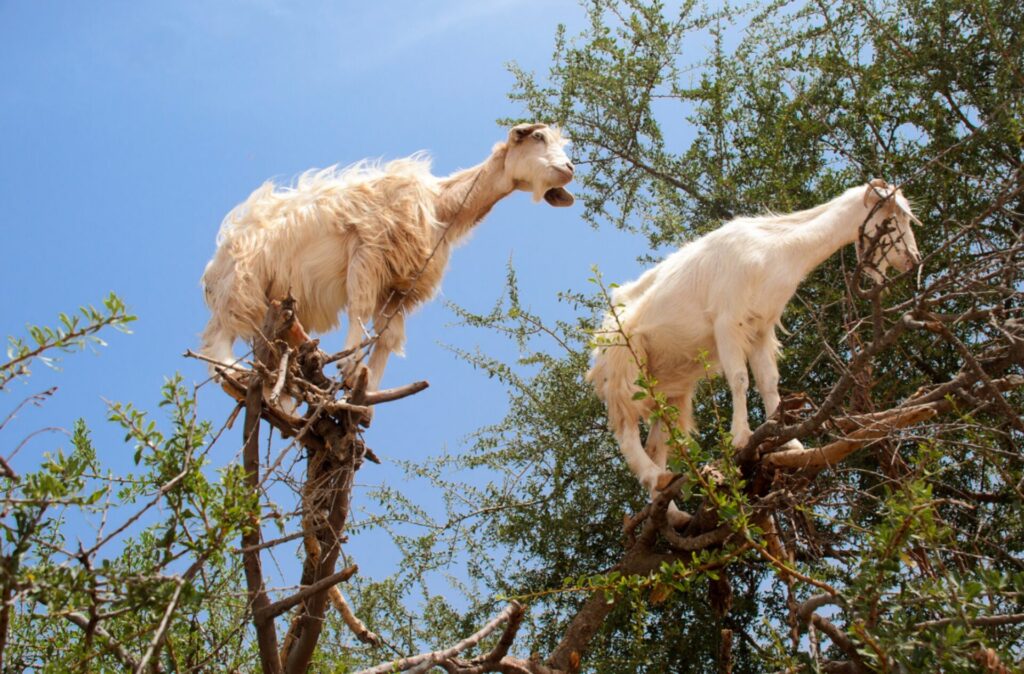
In the sun-kissed landscapes of Morocco, a peculiar sight has captured the imagination of travelers and locals alike: goats climbing argan trees. This phenomenon, often referred to as a myth, has become an iconic representation of the country’s unique wildlife and cultural heritage.

The argan tree, native to Morocco, is a symbol of the country’s rich biodiversity. The sight of goats perched on these trees, feeding on their fruit, is not just a fascinating spectacle but also an important aspect of the local ecosystem.
Goats climbing argan trees have become a hallmark image of Morocco, sparking curiosity and fascination globally. This captivating scene, often captured in photographs, has not only become a symbol of the country’s unique biodiversity but also a significant tourist attraction.
The image of goats perched in argan trees is more than just a viral sensation; it represents the intricate relationship between Morocco’s wildlife and its botanical treasures. Argan trees, native to Morocco, provide a unique habitat for these agile creatures, which climb the trees to feed on the argan fruit.
The phenomenon of goats climbing argan trees has become a major draw for tourists visiting Morocco. Visitors from around the world flock to the southwestern regions of the country to witness this spectacle firsthand. The experience is not just about seeing the goats; it’s about immersing oneself in the natural beauty and rich cultural heritage of Morocco.
While the image is captivating, there’s more to it than meets the eye. The reality behind these photographs often involves local practices and the natural behavior of the goats. Understanding the context of these images can enhance the appreciation of this unique aspect of Moroccan culture and wildlife.
The viral image of goats in argan trees has also sparked interest in Morocco’s conservation efforts and the importance of preserving the argan forest ecosystem. As we explore this phenomenon further, it becomes clear that the image is not just a quirky aspect of Moroccan life but a reflection of the country’s commitment to maintaining its natural heritage.
The image of goats perched on argan trees in Morocco has captured the hearts of many, but there’s more to the story than meets the eye. While the spectacle is undoubtedly captivating, it’s crucial to understand the context and the factors that contribute to this phenomenon.
The argan tree, native to Morocco, is a vital part of the country’s ecosystem. Goats climbing these trees is not just a random act; it’s linked to the nutritional value of the argan fruit. Goats are attracted to the fruit, which is rich in nutrients, and in the process, they climb the trees to access this food source.
This behavior, while unusual, is a testament to the adaptability of goats and the importance of argan fruit in their diet. However, the frequency and spontaneity of this behavior are often exaggerated in tourist circles.
Unfortunately, the popularity of the “goats in trees” phenomenon has led to the creation of staged scenes, particularly in areas frequented by tourists. Some tour operators encourage goats to climb trees by providing them with food, creating a spectacle for visitors. This practice not only distorts the reality of goat behavior but also raises concerns about animal welfare.
Visitors to Morocco should be aware of these practices and approach such scenes with a critical eye. Understanding the difference between genuine wildlife behavior and staged tourist attractions can enhance the travel experience and promote a more responsible form of tourism.
By being informed and cautious, travelers can enjoy the unique aspects of Morocco’s argan tree landscape while supporting ethical tourism practices.
The argan tree, known scientifically as Argania spinosa, is a unique botanical treasure found primarily in southwest Morocco. This tree is not only a vital part of Morocco’s ecosystem but also holds significant cultural and economic importance.
Argania spinosa belongs to the Sapotaceae family. It is a thorny tree that can grow up to 8-10 meters in height. The tree is characterized by its deep roots, which enable it to survive in arid conditions, and its small, yellowish flowers that bloom in the spring.
The argan tree’s fruit is particularly noteworthy. It contains a hard nut that is rich in oil, which is used to produce the highly prized argan oil. The fruit’s pulp is consumed by goats, which are known to climb the trees to feed on the fruit.
| Characteristics | Description |
|---|---|
| Scientific Name | Argania spinosa |
| Family | Sapotaceae |
| Height | Up to 8-10 meters |
| Roots | Deep roots for survival in arid conditions |
The argan tree is endemic to southwest Morocco, where it thrives in the arid and semi-arid regions. The Souss Valley is particularly known for its vast argan forests, which provide a habitat for a variety of flora and fauna.
The argan forest ecosystem is crucial for maintaining biodiversity in the region. It supports a range of plant and animal species and helps to prevent soil erosion and desertification.
The argan tree has adapted remarkably to the harsh desert climate of southwest Morocco. Its deep root system allows it to access water deep beneath the surface, enabling it to survive during periods of drought.
The tree’s thick bark also provides protection against extreme temperatures and helps to conserve water. Additionally, the argan tree’s ability to shed its leaves during times of drought reduces water loss through transpiration.
Nestled in the heart of Morocco, the Souss Valley is home to a unique argan forest ecosystem that supports a wide range of biodiversity. This region is not only significant for its natural beauty but also for its ecological importance.
The Souss Massa National Park, located within the Souss Valley, has been designated as a UNESCO Biosphere Reserve. This recognition underscores the area’s ecological significance and the need for its conservation. The park is a haven for various species, some of which are endemic to the region.
The designation as a UNESCO Biosphere Reserve has brought international attention to the importance of preserving this ecosystem. It has also led to increased efforts in conservation and sustainable management of the argan forests.
The argan forest ecosystem in the Souss Valley is rich in biodiversity. It provides habitat for a variety of flora and fauna, many of which are found only in this region. The forests also play a crucial role in soil conservation, preventing erosion, and maintaining water cycles.
Moreover, the argan forests offer numerous environmental services, including carbon sequestration, which is vital in the fight against climate change. The forests also support local communities by providing resources such as timber, fuelwood, and medicinal plants.
The following table highlights some of the key biodiversity and environmental services provided by the argan forest ecosystem in the Souss Valley:
| Environmental Service | Description | Benefit |
|---|---|---|
| Biodiversity Conservation | Habitat for various species | Supports ecosystem health |
| Soil Erosion Prevention | Roots hold soil in place | Maintains soil quality |
| Carbon Sequestration | Absorbs carbon dioxide | Helps combat climate change |
| Resource Provision | Provides timber, fuelwood, etc. | Supports local livelihoods |
The Souss Valley’s argan forest ecosystem is a vital component of Morocco’s natural heritage. Its preservation is crucial not only for the local environment but also for the global ecosystem.
Goats perched in argan trees are a common sight in Morocco, but the reasons behind this behavior are less well-known. The interaction between goats and argan trees is a complex one, driven by the goats’ search for nutrition and the trees’ unique characteristics.
Argan fruit is rich in nutrients, making it an attractive food source for goats. The fruit’s pulp is particularly valuable, containing proteins and fats that are essential for the goats’ survival in the harsh desert environment. As one local farmer noted,
“Our goats love the argan fruit; it’s like a delicacy for them.”
The nutritional benefits of argan fruit are not limited to the goats; the seeds within the fruit are used to produce argan oil, a valuable commodity in Morocco.
Goats are known for their agility and climbing prowess. In Morocco’s argan forests, this ability allows them to access the fruit of the argan trees, which are often out of reach for other animals. The goats’ behavior is driven by their instinct to find the most nutritious food available. As Dr. Maria Rodriguez, a wildlife expert, explains, “Goats are opportunistic feeders; they’ll climb trees if it means getting to better food.” This behavior is a testament to the goats’ adaptability in the face of environmental challenges.
The relationship between goats and argan seeds is symbiotic. While goats consume the fruit and pulp of the argan tree, they also play a role in dispersing the seeds. However, the seeds that are not digested are often damaged, which can affect the tree’s regeneration. On the other hand, the goats’ consumption of argan fruit contributes to the spread of argan trees through their droppings, which can contain intact seeds. This complex interaction highlights the interconnectedness of the ecosystem in Morocco’s argan forests.
In conclusion, the phenomenon of goats climbing argan trees is driven by a combination of factors, including the nutritional appeal of argan fruit, the goats’ climbing ability, and the symbiotic relationship between goats and argan seeds. Understanding these dynamics provides insight into the unique ecosystem of Morocco’s argan forests.
Argan oil production is not just an industry in Morocco; it’s a cultural heritage. For centuries, the traditional methods of extracting oil from the argan tree have been passed down through generations, playing a significant role in the country’s economy and cultural identity.
The journey of argan oil from the tree to the bottle involves several labor-intensive steps, beginning with the harvesting of argan fruit.
The process starts in late spring when the argan fruit ripens. Local Berber women collect the fruit, often using traditional methods passed down through generations. The fruit is then dried, and the pulp is removed to reveal the argan nut inside.
Cracking the argan nut to extract the kernel is a painstaking process. Traditionally, this is done by hand, requiring great skill and patience. The kernels are then roasted and ground into a paste. The oil is extracted from this paste using a manual press or, in some cooperatives, a mechanical press. The result is a high-quality, extra virgin argan oil rich in nutrients and antioxidants.

A significant aspect of argan oil production is the role of women’s cooperatives. These cooperatives empower local women by providing them with a source of income and training in sustainable argan oil production methods. By supporting these cooperatives, consumers contribute to the economic development of rural Morocco and the preservation of traditional argan oil production.
The traditional argan oil production process is not only a testament to Moroccan heritage but also a vital part of the country’s rural economy. By understanding and appreciating these traditional methods, we can better support local communities and the conservation of argan forests.
For centuries, the argan tree has been a cornerstone of Berber identity and cultural practices. The tree’s significance extends beyond its economic value, deeply ingraining itself into the traditions and folklore of the Berber people.
The argan tree is revered in Berber culture for its multifaceted uses and symbolic meaning. It is not just a source of food and oil but also a symbol of community and resilience. The tree’s ability to thrive in harsh desert conditions has made it a powerful symbol of endurance. In Berber tradition, the argan tree is often associated with hospitality and generosity, as its products are shared among community members.
“The argan tree is a gift from the gods,” a local Berber proverb states, highlighting the tree’s sacred status in Berber culture. The tree’s leaves, fruit, and oil are used in various rituals and ceremonies, further cementing its cultural significance.
Moroccan folklore is rich with stories and legends that feature the argan tree as a central character. One legend tells the story of a young girl who was blessed by the tree, granting her the ability to produce the finest argan oil. Such stories not only entertain but also educate younger generations about the importance of preserving their cultural heritage.
“In the shadow of the argan tree, our stories come alive,” a Berber elder once said, emphasizing the tree’s role in preserving oral traditions.
The argan tree’s presence in Moroccan folklore underscores its integral role in the country’s cultural landscape. By exploring these stories, we gain a deeper understanding of the tree’s significance beyond its practical uses.
The cultural significance of the argan tree is a testament to the rich heritage of the Berber people. As we continue to explore the various facets of argan tree culture, it becomes clear that this tree is more than just a botanical species; it is a living embodiment of tradition, community, and identity.
Argan trees are not just a natural wonder; they are a vital component of rural Morocco’s economy. The argan oil industry, which is derived from the fruit of these trees, has become a significant source of income for many communities.
“The argan tree is a treasure for our community,” says a local cooperative member. “It provides us with a sustainable livelihood and helps preserve our traditional way of life.”
The argan oil industry has experienced substantial growth over the years, driven by increasing demand from both local and international markets. Argan oil is rich in nutrients and has various health benefits, making it a sought-after product in the global cosmetics and food industries.
The export market for argan oil has opened up new opportunities for rural communities. By selling argan oil to international buyers, local cooperatives can generate income that supports their families and communities.
The argan oil industry supports local communities in several ways. Firstly, it provides employment opportunities for women, who are often involved in the production process. This not only empowers women but also contributes to the overall well-being of families.
Moreover, the income generated from argan oil sales helps sustain rural life by enabling communities to invest in their infrastructure, education, and healthcare. As a result, the argan tree plays a crucial role in maintaining the social fabric of rural Morocco.
In conclusion, the economic impact of argan trees on rural Morocco is profound. Through the argan oil industry and its export market, local communities are able to thrive, preserving their traditions while embracing economic opportunities.
As the goats-in-trees phenomenon continues to captivate travelers, Morocco’s argan forests have become a must-visit destination. The allure of seeing goats perched in argan trees has drawn tourists from around the globe, contributing to the local economy and promoting cultural exchange.

Morocco offers several locations where visitors can witness the majestic argan trees and the famous goats climbing them. Two of the most popular regions are near Essaouira and in the Agadir region.
The area around Essaouira is renowned for its picturesque landscapes and argan forests. Visitors can take guided tours to explore the forests, learn about argan oil production, and catch a glimpse of the agile goats as they navigate the trees.
The Agadir region is another hotspot for argan tree enthusiasts. The Souss-Massa National Park, a UNESCO Biosphere Reserve, is home to a significant portion of Morocco’s argan forests. Tourists can explore the park’s trails, enjoy the local flora and fauna, and observe the goats in their natural habitat.
As tourism in argan forests grows, it’s essential to promote ethical tourism practices. Visitors should be mindful of their impact on the local environment and communities. This includes respecting local customs, supporting eco-friendly tour operators, and avoiding actions that could harm the trees or the goats.
By embracing responsible tourism, travelers can help preserve Morocco’s argan forests for future generations while enjoying the unique experience of seeing goats in argan trees.
The Argan forest ecosystem in Morocco faces numerous conservation challenges that threaten its very existence. As a vital component of the country’s biodiversity, preserving these forests is not just an environmental issue but also an economic and cultural necessity.
Argan forests are under threat from several factors, including:
Climate change poses a significant threat to Argan forests, with rising temperatures and changing precipitation patterns potentially leading to desertification. The Argan tree, while adapted to arid conditions, is not immune to the impacts of climate change, which can weaken its resilience and reduce its ability to regenerate.
Desertification is a critical concern as it can lead to the loss of fertile land, reducing biodiversity and ecosystem services. Efforts to combat desertification include reforestation programs and sustainable land management practices.
Several conservation projects are underway to protect and restore Argan forests. These include:
By adopting sustainable practices and supporting conservation projects, it’s possible to mitigate the threats faced by Argan forests and preserve their environmental importance for future generations.
Morocco’s argan forests are at a crossroads, with their future dependent on the balance between tourism, agriculture, and conservation efforts. The argan tree, a symbol of Morocco’s natural heritage, is facing numerous challenges that threaten its long-term sustainability. As we look to the future, it’s essential to consider the measures that can be taken to protect these forests.
The designation of the Arganeraie Biosphere Reserve as a UNESCO World Heritage site has brought international attention to the importance of preserving Morocco’s argan forests. This recognition not only highlights the ecological significance of the argan tree but also underscores the need for concerted conservation efforts. UNESCO heritage statuscan play a crucial role in protecting argan forests by promoting sustainable practices and supporting local communities.
Efforts to protect the argan forests include reforestation programs, sustainable harvesting practices, and the establishment of protected areas. These initiatives aim to maintain the delicate balance between the needs of local communities and the conservation of the argan ecosystem. By supporting sustainable argan oil production, consumers can contribute to the preservation of these forests.
The growing interest in Morocco’s argan forests has led to an increase in tourism, which can have both positive and negative impacts on the local environment. While tourism can provide economic benefits for local communities, it also poses risks to the fragile ecosystem. Balancing tourism and conservation is crucial to ensure that the economic benefits of tourism do not come at the expense of the argan forests’ integrity.
Agriculture, particularly argan oil production, is another critical factor in the sustainability of Morocco’s argan forests. By promoting sustainable agricultural practices, it’s possible to maintain the health of the argan trees while supporting local livelihoods. This balance is essential for the long-term viability of the argan forests and the communities that depend on them.
The future of Morocco’s argan forests depends on our ability to strike a balance between economic development, environmental conservation, and social equity. By working together, we can ensure that these unique ecosystems continue to thrive for generations to come.
The argan tree stands as a testament to Morocco’s rich natural and cultural heritage. The moroccan argan forest is not just a unique ecosystem but also a symbol of the country’s biodiversity and environmental resilience. The fascinating phenomenon of goats in trees morocco has become an iconic representation of this region, captivating visitors and locals alike.
The argan tree importance extends beyond its ecological role; it is deeply intertwined with the local culture, particularly through the production of argan oil, a valuable commodity that supports rural communities. Efforts to conserve and sustainably manage the argan forests are crucial for maintaining this delicate balance between nature and human activity.
As we reflect on the significance of these trees and the challenges they face, it becomes clear that preserving the argan forest is a collective responsibility. By supporting sustainable tourism and local cooperatives, we can contribute to the conservation of this unique ecosystem, ensuring that future generations can continue to marvel at the sight of goats perched in the branches of Morocco’s treasured argan trees.
The argan tree, scientifically known as Argania spinosa, is a native Moroccan tree primarily found in the southwest region, particularly in the Souss Valley and surrounding areas.
Goats climb argan trees to feed on the fruit, which is rich in nutrients. The fruit’s pulp and nuts are a valuable source of nutrition, especially during times when other food sources are scarce.
While goats do climb argan trees to eat the fruit, some images and tourist experiences may be staged or manipulated for better photography opportunities. However, the behavior is rooted in the goats’ natural instinct to feed on argan fruit.
Argan oil is a valuable oil extracted from the nuts of the argan tree. The traditional production process involves harvesting the fruit, removing the pulp, cracking the nuts to obtain the kernels, and then extracting the oil. Women’s argan cooperatives in Morocco play a significant role in this process.
The argan tree holds significant cultural and traditional value, particularly in Berber culture. It is associated with various folklore and legends, and its products, such as argan oil, are integral to local customs and practices.
The argan oil industry provides a vital source of income for rural communities, supporting local economies and promoting sustainable practices. It is an essential part of Morocco’s rural development and women’s empowerment.
Argan forests face threats from climate change, desertification, and over-exploitation. Conservation efforts, including sustainable argan farming practices and protection under UNESCO heritage status, are underway to mitigate these challenges and preserve the forests.
Yes, tourists can visit argan forests, with popular locations including areas near Essaouira and in the Agadir region. It’s essential to practice ethical tourism, respecting local environments and communities.
Souss Massa National Park is a UNESCO Biosphere Reserve that protects a significant portion of Morocco’s argan forests. It plays a crucial role in conserving biodiversity and promoting environmental services within the region.
To ensure the purchase of ethical and sustainable argan oil, look for products that are certified by reputable organizations, sourced from women’s cooperatives, and produced using traditional methods that support local communities and sustainable practices.


