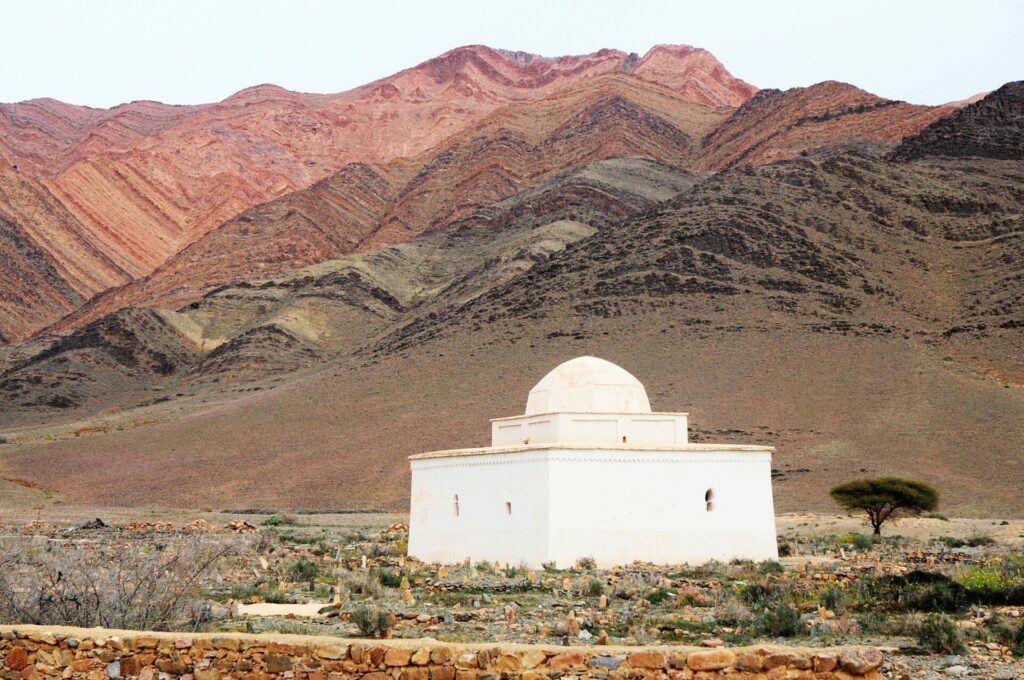



Imagine a bank with no steel vault — only stone, cedar, and trust. The Greniers Collectifs, known locally as Igoudar (singular: Agadir), are exactly that. These extraordinary fortified granaries represent a masterpiece of indigenous Berber engineering. Perched on near-inaccessible peaks across Ait Baha, Amtoudi, and Tasguent, they are among Morocco’s most overlooked architectural wonders. Furthermore, they are arguably the oldest communal banking system ever devised.
Each Agadir functioned as a communal bank long before currency existed. Accordingly, every family owned a private cell — a locked stone chamber — inside the fortress walls. Families deposited grain, olive oil, honey, jewellery, and even deed titles there. Therefore, wealth was tangible, communal, and protected.
Governing this system was the Lhouda: a strict body of customary law. The Lhouda defined deposit rules, access rights, and conflict resolution. Consequently, no family could access another’s cell without formal permission. This legal framework gave the Agadir its institutional legitimacy.
Moreover, every Agadir had an Amin — a trusted guardian elected by the community. The Amin managed keys, recorded transactions, and resolved disputes. In short, he was history’s first bank manager. This role demonstrates that Berber architecture was never merely physical. It was deeply social and juridical.

The construction of the Igoudar relied entirely on dry-stone masonry. Builders stacked local schist and limestone without mortar. Yet the walls have endured centuries of seismic activity and harsh mountain winters. This reveals an extraordinary understanding of load distribution and geology.
Inside, cedar wood doors sealed individual cells. Cedar was chosen deliberately — its natural oils repel insects and resist humidity. Additionally, the thick stone walls created a stable microclimate. Summer heat could not penetrate. Winter cold was moderated by the rock’s thermal mass. As a result, grain stored inside remained edible for decades. Some accounts suggest storage of up to forty years without significant spoilage — a feat well documented in historical accounts of Amazigh granary engineering.
Perhaps most impressive are the floating stone staircases. Craftsmen cantilevered flat stone slabs from the walls, creating stairways with no central support. This technique reduced weight on the structure while maximising internal space. Visually, these staircases remain one of the most striking features of Berber architecture in the Anti-Atlas Morocco region.
Beyond engineering, the Greniers Collectifs represent a philosophy of collective survival. During droughts — common across the arid Souss-Massa plain — the Agadir became a lifeline. Communities withdrew stored reserves and redistributed food across affected families. Therefore, the granary directly prevented famine. It transformed individual surplus into collective resilience.
During periods of Siba — the recurring episodes of tribal unrest that challenged Makhzen authority — the Agadir served as a sanctuary. Families fled to the fortress carrying their most valuable possessions. Because of its elevated position and reinforced walls, the Agadir was virtually impregnable. Consequently, it protected not only grain but also genealogical records, marriage contracts, and cultural memory.
This dual role — granary and refuge — underlines the concept of tribal banking in its broadest sense. The Agadir stored not merely food, but identity itself.
Today, many Igoudar sites face serious deterioration. Depopulation of mountain villages has left numerous granaries without custodians. However, growing international attention is beginning to shift that trajectory. Several sites in the Souss-Massa region have undergone restoration with support from local associations and the Moroccan Ministry of Culture.
UNESCO has acknowledged the significance of these sites within broader discussions of earthen and vernacular architecture. Additionally, organisations such as the Getty Conservation Institute have highlighted the Igoudar as models of community-centred heritage preservation.
For the Souss-Massa region, these granaries hold immense potential for sustainable cultural heritage tourism. Visitors to Amtoudi or Ait Baha already encounter living heritage — communities who still use some granaries for storage. Furthermore, guided circuits through Agadir villages could generate income, protect sites, and transmit knowledge to younger generations.
The Greniers Collectifs of the Anti-Atlas Morocco are not museum pieces. They are living proof that Amazigh communities built sophisticated, just, and resilient systems long before modernity arrived. The Igoudar gave the world its first bank manager, its first communal legal code, and its first climate-controlled storage. Above all, they remind us that architecture, at its finest, is always an act of solidarity.
If you are a traveller, a student of Berber architecture, or simply someone who values authentic cultural heritage — visit an Agadir. Climb its stone steps. Stand inside its cedar-scented cells. And consider what it means to build something that lasts not just decades, but centuries.